Tooth Brace Alternatives That Can Still Improve Smiles in 2026
At the SmileSpecialist® Centre, we never limit your treatment options. Different people have different needs, different goals, and different budgets — so we help you explore ALL realistic possibilities:
- Traditional orthodontic braces (usually 1–3 years)
- FastBraces® – typically months, not years
- Ceramic / tooth-coloured cosmetic brace systems (around 6 months for the front teeth)
- Advanced restorative options such as veneers or crowns (weeks)
- Same-day tooth whitening
- Or of course, choosing no treatment at all
To give you accurate and personal advice, we must examine you first and allow time for discussion. Our detailed 45-minute Smile Assessment — including a full written estimate and tailored options — is now £99 (reduced from £149) at our SmileSpecialist® Centre in Haworth near Keighley, Bradford and Leeds.

Some adults feel that wearing fixed braces for 1–3 years just isn’t realistic socially or professionally, even with modern discreet systems. If traditional orthodontics isn’t for you, there are still several ways to improve your smile, for example:
- Shorter-term cosmetic brace systems focused on the front teeth (often ~6 months)
- FastBraces® – typically months rather than years
- Advanced restorative options (veneers, crowns, bonding, implants, bridges)
- Professional tooth whitening to brighten and freshen your existing smile
In some cases, a combination of techniques is ideal — for example, subtle reshaping, whitening and a few carefully planned veneers or crowns.
In suitable cases, yes — especially where the main concern is the appearance of the front teeth, rather than a severely compromised bite throughout the whole mouth. Here is one real example treated by Dr Kilcoyne:
- Very twisted and uneven front teeth
- Working adult who did not want any braces
- Solution completed in as little as 2 weeks
- No extractions and no root canal treatment were needed

How much can such a change improve confidence at work and socially?
The negative images below help show the severity of the original unevenness, and the degree of improvement achieved:


Not everyone is a candidate for brace-free solutions, but where appropriate, advanced restorative techniques can offer a shorter timeframe and a powerful cosmetic result.
Many patients have more than one issue at the same time — for example:
- Missing teeth
- Worn or broken teeth
- A poor or uncomfortable bite
- Uneven shape, colour and alignment
- A big impact on self-confidence
With specialist-level planning, it is often possible to address several of these concerns together, blending health, function and aesthetics into a single plan.
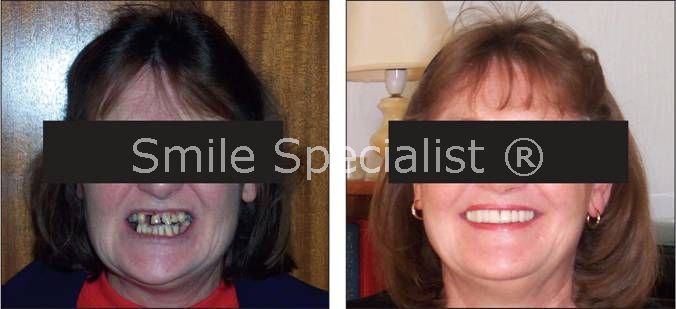
In many advanced cases, braces are only one possible route. Alternatives to braces may involve:
- Whitening and contouring
- Veneers and crowns for shape and colour
- Implants or bridges to replace missing teeth
- Bonding to rebuild worn edges
- Or a carefully staged combination of the above
The key is careful diagnosis, realistic planning and sufficient experience to deliver predictable results in many skilful ways.
All treatment options have pros and cons. In broad terms:
- Braces move the natural teeth into a better position, usually over months or years. They are generally conservative of tooth tissue but require time and commitment.
- Restorative alternatives (veneers, crowns, bonding, implants, etc.) can achieve faster cosmetic changes, but may require more reshaping or rebuilding of teeth, and they have their own maintenance implications over time.
The right balance for you depends on:
- Your current dental health and bite
- How much time you have
- How you feel about braces vs restorative work
- Your budget and long-term goals
This is why a detailed, honest consultation is essential before any big decision.
Not every celebrity or public figure chooses braces. Many opt for carefully planned restorative dentistry instead, to improve:
- Tooth shape and proportions
- Colour and brightness
- Symmetry of the smile in photos and on camera

Whether you prefer a “Hollywood” look or something more subtle and natural, the principles of planning and precision are the same – and they can be adapted sensibly for everyday life and realistic budgets.
Yes — we periodically run special offers to make high-quality cosmetic and restorative dentistry more accessible, while still maintaining Specialist-level standards.

Click here to view current Special Offers from SmileSpecialist®.
Remember, the cheapest option is not always the best value in the long term. Prevention, quality and long-term planning usually save money — and problems — later.
Dr Kilcoyne is a fully registered UK Specialist in Prosthodontics, which includes:
- Implants and mini-implants
- Crowns and veneers
- Precision dentures and bridges
- Bonding and complex restorative reconstruction

This combination of training, experience and a proven track record allows us to offer a wide range of solutions — from simple improvements to full smile makeovers — with a focus on long-term success as well as immediate appearance.
Whether you choose your care with us or elsewhere, we hope this website helps you ask better questions and weigh up which options best match your needs, budget and long-term wishes for your dental health.
You can learn more about specific topics here:
- Cosmetic Dentistry
- Tooth Veneers
- Tooth Whitening
- Implants & Mini-Implants
- Ceramic Crowns
- Gum Disease
- Bad Breath
- Root Canal Treatments
Prevention is always better — and cheaper — than cure. That includes avoiding poor choices based on cost alone.
Wishing you good dental health and a smile to be proud of, from all at the SmileSpecialist® Team.
The SmileSpecialist® Centre is based at 9–13 Station Road, Haworth, Keighley, West Yorkshire, BD22 8NL – a convenient location between Leeds and Manchester, within reach of Bradford, Halifax and the wider Yorkshire & Lancashire regions. We are opposite the steam railway station at the bottom of the village hill, close to the new Co-op store.

- Details
After Root Canal Treatments 2026 onwards....
Root Canal Work cleans out any infected nerve and infection debris, then seals with antiseptic root filling, to help preserve the rest of the tooth. Root Canal Work often precedes any Advanced Cosmetic Dentistry, including Crowns, Dental Implants, mini Implants, immediate Dental Implants, Bridges, Veneers, Precision Dentures, Tooth Bleaching, Teeth Whitening, Cosmetic Bonding, Latest Ceramic Restorations etc, involved in treating Tooth wear and worn, uneven teeth, Periodontal Plastic Surgery, TMJ's, Difficult Occlusions, Excessive Wear Cases and even Denture cases needing something to hold onto to.
CORONA VIRUS & SAFETY UPDATES 2025 : Thank you for your continued patience as there are still occasional outbreaks of Covid, 100 day cough and things like Monkey Pox to monitor, as people mix and travelled more and frankly, most don't clean hands as well as they used to.
So please wash your hands often (a common spread disease contact with people and handles), especially before eating snacks or fast foods, pizza etc.
After you have had a Root Canal Treatment (RCT) involving Root Filling, please follow your Patient Information and Instructions after Root canal treatment (RCT), which is has involved removing the nerves from roots and deep cleaning that often takes two or more appointments to complete. A temporary covering is placed to protect the tooth between appointments, so given this is more complex treatment than average, it is not unusual to have some temporary discomfort after treatment visits.
Also after each appointment when anaesthetic has been used, your lips, teeth and tongue may be numb for several hours. Avoid any chewing until the numbness has completely worn off and don't burn your mouth on hot drinks! Between appointments, it's common (and not a problem) for a small portion of your temporary filling to wear away or break off. However, if the entire filling falls out, or if a temporary crown comes off, call your dentist so it can be replaced, to stop further bacterial invasion/infection.
It's normal to experience some discomfort for several days after a root canal appointment, especially when chewing. To control discomfort, take pain medication as recommended. If antibiotics are prescribed, continue to take them for the indicated length of time, even if all symptoms and signs of infection are gone.To further reduce pain and swelling, rinse three times a day with warm salt water; dissolve a teaspoon of salt in a cup of warm water, then rinse around for at least 10 seconds, spit out and repeat again.
To protect the tooth and help keep your temporary in place:
Avoid eating sticky foods ( toffees, gum, sweets etc.)
Avoid hard foods (nuts, granary seeds, biscuits etc.) and hard items,
such as ice,
fingernails, pens or other "habits".
Example below shows before and after X-ray views of a 3 rooted molar
tooth that needed root canal treatment
It's not easy getting to the ends of the roots of all the canals
present - it is Dentistry's equivalent to keyhole Surgery !!!

Sometimes, despite the Dentist's best efforts, the RCT is unsuccessful. Success rates are about 85%, so about 1 in 7 fail and the tooth is lost if any re-treatment hasn't worked either.
This is usually due to resistant infections, complex anatomy, canal blockages or narrowing, that cannot be overcome (see diagram above).
Also even if the root canals are well cleaned and sealed as the above X-ray shows, a resistant infection may still prevent healing. That's just a biological risk for everyone!
This is why there is a recognised failure rate with RCT, though often 6 out of 7 are successful. If you are having a tooth with a failing RCT redone, then the overall success rate lowers further too, as re-treatment is always more difficult.The next step after root canal treatment is often the placement of a crown. This will usually be done after a suitable healing/monitoring period.A crown covers and helps protect the tooth from breaking in the future. If your bite feels uneven, if you have persistent pain, or you have any other questions or concerns, please contact your Dentist.
The Importance of good Aftercare and Maintenance!
As well as regular check-ups to your Dentist to prevent problems (or at least catch them very early-on), please follow your aftercare advice and don't neglect your Toothbrushing and Flossing Techniques that reduce Dental Plaque attack on your teeth, gums and dentistry work.
Want to know more about brushing and Flossing techniques that prevents bad breath and keeps your Mouth and Dentistry Healthier too?
Our SmileSpecialist® Centre Dental Practice is on Station Road, opposite the Steam Railway Station at the bottom of the village hill, just opposite the new Co-Op store.
Dr.Kilcoyne has won National Prizes for the Quality of Patient Services, so you don't have to compromise ! Please do ask your regular Dentist for a Specialist referral to us, or if this is impractical for some reason, you may refer yourself directly.
*Dr.Kilcoyne is a fully GDC Registered, Trained Dentist and Specialist* in the Functional & Cosmetic aspects of Tooth Implants, Crowns, Bridges, Precision Dentures, mini-implants, Ceramics, Veneers, Occlusion, Bonding and Restoring Smiles.
*Dr.Kilcoyne is a UK registered Specialist in Prosthodontics (GDC No.58373) which includes The Functional and Cosmetic Dentistry aspects of Crowns, Dental Implants, Bridges, Veneers, Fillings, Dentures, Bonding etc. Please go to our MAKE an APPOINTMENT page if you'd like to access his Expertise.
- Details
After Dental Tooth Extraction instructions, for 2026.
After a dental tooth extraction of teeth or roots, there are several sensible precautions you can take, to allow nature's healing to work best for you.
Some people are surprised how big the roots of teeth are, usually bigger than the visible Crown of the tooth visible above the gum. Please see a picture below of a tooth Dr.Kilcoyne extracted in such a careful way that not only was the whole tooth with it's 3 roots removed in one piece, but also the abscess sac attached to the back root was removed whole too, to help remove the bad tooth with its infection, which should allow healing after the extraction to be as comfortable and quick as possible. However, the skill of the extraction technique is just one important factor.
CORONA VIRUS & SAFETY UPDATES 2026 : Thank you for your continued patience with our systems, as there are still occasional outbreaks of Covid, Flus and Norovirus etc; people mix and travel more and frankly, most don't clean their hands as well as they used to.
So please wash your hands often (a common spread of diseases are contacts with people and handles), especially before eating snacks or fast foods, pizza etc.
See this Video link below showing a Tooth after our careful extraction, where we managed to keep fractured roots intact AND still remove the infection abscess sacs forming in the jawbone at the end of the roots too:
Click this link here to go to the Extracted tooth Video
After an extraction, it's important for a blood clot to form to stop the bleeding and begin the healing process. That's why your dentist will ask you to bite on a gauze pad for 5 minutes or so, after an extraction. Pressure stops bleeding - If bleeding or oozing continues after you remove the gauze pad, place another gauze pad on the area and bite firmly for another 15 minutes. You may have to do this several times. Do NOT dab the pad on and off as this stops a clot forming, keep the pressure on constantly.After the blood clot forms, it's important to protect it, especially for the next 24 hours.
It's also important to:
NOT Smoke at all
NOT Suck through a straw
NOT Rinse your mouth vigorously
NOT do heavy exercising or lifting
These activities would dislodge the clot and slow down healing. Limit yourself to calm activities for the first 24 hours. It's a case of "Walk rather than Run". This keeps your blood pressure lower, reduces new bleeding, and helps the healing process to get a good start after an extraction.

After the tooth is extracted you may feel some pain and have some swelling. You can use an ice pack (15 minutes on, 15 minutes off) to keep this to a minimum. The swelling usually starts to go down after 48 hours and is normal if you had a difficult extraction or say 4 wisdom teeth out.
To control discomfort, take pain medication as recommended. Don't take medication on an empty stomach or nausea may result. If antibiotics are prescribed, continue to take them for the indicated length of time, even if all symptoms and signs of infection are gone.
Drink lots of fluids
Eat only soft, nutritious foods on the day of the extraction
Don't use alcoholic beverages
Avoid hot and spicy foods
You can begin eating normally the next day, or if not by then, as soon as it's comfortable. Gently rinse your mouth with warm salt water three times a day (put a teaspoon of salt in a cup of warm water, gently rinse-swish-spit). Also, rinse gently after meals. This helps keep food out of the extraction site. It's very important to resume your normal dental routine after 24 hours. This should include brushing your teeth and tongue and flossing at least once a day. This will speed healing and help keep your breath and mouth fresh. Call your dentist right away if you have heavy bleeding, severe pain, continued swelling after two or three days, or a reaction to the medication. After a few days, satisfactory healing can happen, however, if you have any concerns we'd be pleased to help you.
Unless you want Extractions to become a regular event for you, there is a better way so as well as regular check-ups to your Dentist to prevent problems (or at least catch them very early on), please follow your aftercare advice and don't neglect your Toothbrushing and Flossing Techniques that reduce Dental Plaque attack on your teeth, gums and dentistry work.
Here are some webpage links for advice after tooth Extractions at one extreme, or alternatives to Dental Implants at the other extreme, or even Tooth Braces alternatives for straighter teeth or nices smiles, that don't take years like traditional braces. If curious you can click these links for After Tooth Extraction advice or Dental Implant alternatives or Tooth Braces alternatives web pages too.
The Importance of good Aftercare and Maintenance!
So as well as regular check up examinations for prevention DO please follow ALL your aftercare advice, reduce sugar attacks and don't neglect your Toothbrushing and Flossing Techniques that reduce the soft bacterial Dental Plaque that damages your teeth, gums and dentistry work. This may sound like boring advice but you must ACT UPON it regularly for your own good - it is NEVER TOO LATE to make improvements. Not easy, but smart, because good self-care efforts COMBINED with expert dental professional care, is the optimum plan to first get health and stability established, then to KEEP IT that way, ideally!
Want to know more about tooth brushing and Flossing techniques that prevents bad breath and keeps your Mouth and Dentistry Healthier too? Then please click these for Tooth Brushing Information or Dental flossing techniques or Preventing Gum Diseases links.
Dr.Kilcoyne is a fully registered UK Specialist in Prosthodontics ,which includes Teeth Implants, Crowns, Veneers, Dentures, Bonding etc, to Restore or Replace teeth functionally and cosmetically so you can have a Smile that you can be proud of, without compromise. Yes all this expertise, experience and excellent track-record have a price, but we still believe it is Good Value for the level of Specialist Quality one is getting and can be confident in.
Dr.Kilcoyne has won National Prizes for the Quality of Patient Services, so you don't have to compromise ! Please do ask your regular Dentist for a Specialist referral to us, or if this is impractical for some reason, you may refer yourself directly.
*Dr.Kilcoyne is a fully GDC Registered, Trained Dentist and Specialist* in the Functional & Cosmetic aspects of Tooth Implants, Crowns, Bridges, Precision Dentures, mini-implants, Ceramics, Veneers, Occlusion, Bonding and Restoring Smiles.
Wishing you good Dental Health AND a Smile to be proud of, from all at the SmileSpecialist® Team.
Filling Replacements
- Details
Dental Filling Replacements & Restoring broken teeth, options 2026 onwards....
Replacement fillings, cosmetic materials, bonded fillings and restorations, Cosmetic Dentistry options including various cosmetic white fillings to advanced Dental Implants, mini Implants, immediate Dental Implants, Ceramic tooth coloured Fillings, Crowns, Bridges, Veneers, Precision Dentures, Tooth Bleaching, Teeth Whitening, Cosmetic Bonding, Latest Ceramic Restorations, Second Opinions, Smile Profiling, Gum Diseases, Tooth wear and worn, uneven teeth, Periodontal Plastic Surgery, TMJ's, Difficult Occlusions, Excessive Wear Cases, Root canal treatment, Trauma and Emergencies; Anxious or Nervous Patients are well looked after by us and welcome too!

What is the best type of filling replacement for me?
The answer is often the same type of filling with the same or different materials; or even a different type of restoration that isn't a filling, if getting too big or complex or hollowing and weakening the tooth more.
Filling types:
1. Amalgam - this contains Mercury, Silver, Copper, Nickel and Zinc usually, mixed (amalgamated) together to make an alloy. Amalgam has been around for over 100 years, though it's formulation hasn't changed much. Current scientific evidence (01/01/01) suggests that although it contains Mercury (a known poison), once mixed it does not harm health noticeably. Many people prefer not to have Amalgam fillings put back in their mouths, even if they do last an awful long time. Despite the current evidence, more and more patients are requesting non-mercury-containing restorations.
2. Composites - these have been around 40 years or more and have progressed from being chemically set, to being set with a blue light. They are hard, strong (not quite as strong as the amalgam), tooth-coloured and don't contain Mercury. They do, however, contain some plastic chemicals that may mimic female hormones (Bisphenol-A), but there is no evidence of this happening in Dentistry. In fact, softer plastics like carrier bags and cling film contain more Bisphenol-A than hard Dental fillings. There are different Composites for different purposes, including microfills and Hybrids. These can be chemically bonded to your teeth to both seal and retain your restorations. There are also many Cosmetic choices available too, with very natural effects possible using mamelon contours and layering techniques with translucencies.
3. Glass-Ionomers - These were a British discovery in the 1970's. They do not shrink, are tooth-coloured and naturally bond and seal to tooth substance. They do not contain plastics or mercury, but they do not wear as well as Composites or Amalgam. They can, however, be combined with these restorations in certain circumstances and leach out fluoride to prevent new decay. Glass-Ionomers are a flexible versatile restorative that chemically is more biocompatible than many other alternatives.
4. Compomers - these are combinations of Glass-Ionomer & Composites. Unfortunately, they are prone to expanding later so are not recommended for bonding porcelain work on with, as this can then cause cracking later.
5. Inert Glasses - these are pre-formed shaped restorations that can be used in areas of high stress and have the same wear characteristics as normal teeth. They can be bonded to tooth substance and Composite materials, without the disadvantages of other restoratives. Materials like these (eg: Cerana) are the most biocompatible, strong and aesthetic restorative to give a tooth strength and beauty combined, on the same visit.
6. Indirect fillings - these are made in a laboratory or in a milling machine and are then cemented into your mouth. They take longer to do, often involve several visits and cost more than the previous alternatives. They look good, are strong and can be bonded too. Indirect fillings such as inlays or onlays can be metal, gold or porcelain and are more suitable for larger holes or replacement fillings, where the extra strength of a Crown is not needed.There are many ways to restore a filled tooth, depending upon your cosmetic and cost limitations, as well as the biting forces it will be subjected to.
Sometimes, even the strongest fillings fail (usually because of the tooth being hollow and weak) and another alternative such as Crowns or Bridges need to be considered.
Of course we all realise later in life the best filling is healthy natural tooth, so early prevention visits, sealants, fluoride, reduced sugar-attacks on teeth etc, ALL pay us a health dividend later - that is why we emphasise healthy maintenance too !!!
Our SmileSpecialist® Centre Dental Practice is on Station Road, opposite the Steam Railway Station at the bottom of the village hill, just opposite the new Co-Op store.
Dr.Kilcoyne has won National Prizes for the Quality of Patient Services, so you don't have to compromise ! Please do ask your regular Dentist for a Specialist referral to us, or if this is impractical for some reason, you may refer yourself directly.
*Dr.Kilcoyne is a fully GDC Registered, Trained Dentist and Specialist* in the Functional & Cosmetic aspects of Tooth Implants, Crowns, Bridges, Precision Dentures, mini-implants, Ceramics, Veneers, Occlusion, Bonding and Restoring Smiles.
As always, Prevention is cheaper and better than Cure - that includes Preventing making bad choices based on costs alone!
Bridge Maintenance
Dental Bridge Maintenance, tips for 2026 onwards...
Tooth Bridge maintenance for all Dental Bridges is so very important, because they are complex and the teeth they are attached to, could still decay or get gum disease or infection later.
As a tooth-Bridge is attached to and dependent on the supporting teeth, if these teeth were damaged or lost then so would the bridge be, with any larger gap then perhaps being too wide for an even longer bridge, meaning more complex implants or removable part-dentures instead!
Bridges often need replacing on average every 8-12 years, but the remaining tooth & roots need to remain healthy and strong to carry a replacement bridge too!
CORONA VIRUS & SAFETY UPDATES 2026 : Thank you for your continued patience with our systems, as there are still occasional outbreaks of Covid, bad Flus and resistant Norovirus etc; people mix and travel more and frankly, most don't clean their hands as well as they used to.
Top Tip - preventively wash your hands often (a common spread of diseases are contacts with people and handles), especially before eating snacks or fast foods, pizza etc.
With tooth Bridges, one can also get food particles, grains or pips stuck under the Bridge pontic, which replaces the missing tooth, so special bridge cleaning methods are needed, such as "super-floss" to clean underneath these bridge areas, to prevent bad breath and/or infection resulting from not cleaning the bridge properly.

A dental bridge depends on the health of the adjacent teeth and gums for support.
To care for your bridge, brush and floss normally after each meal and don't miss regular dental visits and cleanings to prevent problems too.
Superfloss and floss threaders are effective self-help tools for keeping the area under your bridge plaque-free. Superfloss has a stiff end that helps in threading it through tight areas, and a fuzzy tufted segment that can remove plaque as you floss. Insert the superfloss under the bridge and use it to floss the sides of the teeth and under the bridge.
Floss threaders also aid in removing plaque. Pull out about 18 inches of floss, insert it through the floss threader, and then use the threader to insert the floss under your bridge. Floss to remove food particles and plaque from the sides of the teeth and under the bridge.
Use the same procedure to care for your temporary bridge, being careful not to dislodge it as you brush and floss. If it does come loose, gently re-attach it; call your dentist if your temporary bridge frequently comes loose. Depending on the situation, your dentist may give you additional tools and recommend techniques to help keep all the areas around your bridge free from plaque build up.
Regular visits to your Dentist are also important to prevent or discover any problems early.
The right Toothbrushing and Flossing Techniques do reduce damaging Dental Plaque.
Want to know more about brushing and Flossing techniques that prevents bad breath and keeps your Mouth and Dentistry Healthier too?
Our SmileSpecialist® Centre Dental Practice is on Station Road, opposite the Steam Railway Station at the bottom of the village hill, just opposite the new Co-Op store.
Dr.Kilcoyne has won National Prizes for the Quality of Patient Services, so you don't have to compromise ! Please do ask your regular Dentist for a Specialist referral to us, or if this is impractical for some reason, you may refer yourself directly.
*Dr.Kilcoyne is a fully GDC Registered, Trained Dentist and Specialist* in the Functional & Cosmetic aspects of Tooth Implants, Crowns, Bridges, Precision Dentures, mini-implants, Ceramics, Veneers, Occlusion, Bonding and Restoring Smiles.
The Importance of good Aftercare and Maintenance!
As well as regular check-ups to your Dentist to prevent problems (or at least catch them very early-on), please follow your aftercare advice, reduce sugar attacks and don't neglect your Toothbrushing and Flossing Techniques that reduce the Dental Plaque that damages your teeth, gums and dentistry work.
Want to know more about brushing and Flossing techniques that prevents bad breath and keeps your Mouth and Dentistry Healthier too? Then please click these for Tooth Brushing Information or Dental flossing techniques or Preventing Gum Diseases links.
*Dr.Kilcoyne is a UK registered Specialist in Prosthodontics (GDC No.58373) which includes The Functional and Cosmetic Dentistry aspects of Crowns, Dental Implants, Bridges, Veneers, Fillings, Dentures, Bonding etc.
Please go to our MAKE an APPOINTMENT page if you'd like to access his Expertise, for YOUR benefit, or simply call us on 01535644005 and leave your details?

Best wishes from the whole SmileSpecialist Team and remember, Prevention is cheaper and better than Cure - that includes Preventing making bad choices based on costs alone !